The whir and hum of a laser printer are a familiar sound in offices and homes worldwide, a testament to its efficiency and crisp output. Yet, the cost of replacement toner cartridges, often surprisingly high, frequently sparks a search for more economical solutions. This quest inevitably leads many to consider third-party toner cartridges – alternatives promising significant savings. But in 2026, with evolving printer technology and diverse market offerings, a crucial question remains: are these compatible options truly safe and reliable for your laser printer? Let’s cut through the myths and examine the facts to help you make an informed decision for your printing needs.
What Are Third-Party Toner Cartridges? (Definition and Types)
When we talk about third-party toner cartridges, we are referring to any toner product not manufactured by the original equipment manufacturer (OEM) of your printer, such as HP, Canon, or Brother. These alternatives are broadly categorized into two main types:
- Compatible Cartridges: These are brand-new toner cartridges produced by independent third-party companies. They are designed from scratch to function identically to their OEM counterparts, fitting specific printer models and aiming to deliver similar performance and page yield.
- Remanufactured Cartridges: Unlike compatibles, remanufactured cartridges begin their life as used OEM cartridges. They undergo a rigorous process of cleaning, inspection, replacement of worn parts, refilling with new toner, and thorough testing to ensure they meet quality and performance standards. This approach emphasizes sustainability by reusing existing components.
Both compatible and remanufactured options offer a cost-effective alternative to OEM toner, but their quality and reliability can vary significantly depending on the manufacturer.
Advantages of Using Third-Party Toner Cartridges
The appeal of third-party toner cartridges is multifaceted, extending beyond just the initial cost. For many users, the benefits present a compelling argument for making the switch.
Cost Savings
|
Our Picks for the Best Laser Printer in 2026
As an Amazon Associate I earn from qualifying purchases.
|
||
| Num | Product | Action |
|---|---|---|
| 1 | HP Laserjet MFP M234dw Wireless Printer, Print, scan, Copy, Fast speeds, Easy Setup, Mobile Printing, Best-for-Small Teams, Instant Ink Eligible |

|
| 2 | Brother DCP-L2640DW Wireless Compact Monochrome Multi-Function Laser Printer with Copy and Scan, Duplex, Mobile, Black & White | Includes Refresh Subscription Trial(1), Works with Alexa |
|
| 3 | HP LaserJet MFP M235sdw All-in-One Laser Wireless Printer, Scan/Copy, Black & White, Duplex, Best-for-Office |
|
| 4 | Brother HLL6210DW Business Monochrome Laser Printer with Large Paper Capacity, Wireless and Gigabit Ethernet Networking, Advanced Security Features and Mobile Printing (Renewed Premium) |
|
| 5 | Brother HL-L2460DW Wireless Compact Monochrome Laser Printer with Duplex, Mobile Printing, Black & White Output | Includes Refresh Subscription Trial(1), Works with Alexa |
|
| 6 | Canon imageCLASS MF284dw Wireless Black & White Laser Printer – All-in-One for Home Use, Print/Copy/Scan, 2-Sided Printing, 35 PPM, Auto Doc Feeder, Mobile Device Compatible, Starter Toner Included |
|
| 7 | Brother DCP-L2640DW Wireless Compact Monochrome Multi-Function Laser Printer with Copy and Scan, Duplex, Black & White Output | Includes Refresh Subscription Trial(1), (Renewed Premium) |
|
| 8 | Brother HL-L2405W Wireless Compact Monochrome Laser Printer with Mobile Printing, Black & White Output | Includes Refresh Subscription Trial(1), Works with Alexa |
|
| 9 | Brother HLL3280CDW Wireless Compact Color Laser Printer, Duplex, Mobile Printing & Ethernet | Includes 2 Month Refresh Subscription Trial¹, Amazon Dash Replenishment Ready (Renewed Premium) |
|
| 10 | Brother MFC-L2820DW Wireless Compact Monochrome All-in-One Laser Printer with Copy, Scan and Fax, Duplex, Black & White | Includes Refresh Subscription Trial(1), Works with Alexa |
|
Perhaps the most significant advantage, compatible and remanufactured toner cartridges typically offer substantial savings compared to OEM versions. It’s not uncommon to find third-party options priced 30% to 80% lower than brand-name cartridges. For businesses and individuals with high-volume printing demands, these savings can accumulate rapidly, translating into thousands of dollars annually. This cost-efficiency allows budgets to stretch further, making professional-quality printing more accessible.
Environmental Benefits
In an era where sustainability is paramount, third-party toner cartridges often present a more eco-conscious choice. Remanufactured cartridges, by their very nature, reduce waste by giving used OEM components a second life, decreasing the demand for new plastics and raw materials. Many compatible cartridges are also produced using recycled plastic content, further lowering their environmental footprint and contributing to a circular economy. Choosing these alternatives helps minimize landfill waste and reduce carbon emissions associated with new manufacturing.
Wide Availability
The market for third-party toner is vast and continually growing, offering a broad selection of cartridges for nearly every laser printer model. This wide availability means consumers have numerous options from various suppliers, both online and in physical stores. This accessibility often translates to quicker delivery and the ability to purchase in bulk, providing convenience and flexibility for managing printing supplies.
Comparable Print Quality
While often a point of contention, modern advancements in manufacturing and toner formulation mean that high-quality third-party cartridges can deliver print results nearly identical to OEM cartridges for everyday documents and text. Reputable compatible brands invest in research and development to match the toner composition and chip technology of original cartridges, ensuring sharp text, clear graphics, and consistent output for most standard printing tasks.
Disadvantages and Potential Risks of Third-Party Toner Cartridges
Despite the attractive benefits, using third-party toner cartridges is not without its considerations and potential risks. It’s crucial for consumers to be aware of these drawbacks to make a truly informed decision.
Inconsistent Quality
One of the primary concerns with third-party toner is the variability in quality. Unlike OEM cartridges, which adhere to strict manufacturing standards, the quality control among third-party manufacturers can differ significantly. Users may encounter issues such as faded prints, streaking, smudging, inconsistent toner density, or inaccurate color reproduction. This inconsistency can be particularly problematic for professional applications where print quality is paramount, such as marketing materials or high-resolution graphics.
Compatibility Issues
While designed to be compatible, some third-party cartridges may face recognition problems with your printer. This can lead to annoying error messages, the printer refusing to print, or requiring manual overrides. These issues often stem from discrepancies in the cartridge’s chip technology or physical dimensions, which might not perfectly align with the printer’s sensors or internal mechanisms. Such compatibility glitches can disrupt workflow and negate any cost savings through lost productivity.
Potential for Printer Damage
Poorly manufactured third-party cartridges pose a risk of physical damage to your laser printer. Leaking toner, for instance, can contaminate internal components like the drum unit or fuser, leading to costly repairs or even irreversible damage. Improperly fitting cartridges can also cause increased wear and tear on printer parts over time, shortening the device’s lifespan. These risks are typically associated with very cheap, unverified products from less reputable suppliers.
Firmware Updates
Printer manufacturers frequently release firmware updates that can sometimes intentionally or unintentionally affect the functionality of non-OEM cartridges. These updates might include software designed to detect and block third-party consumables, displaying warnings or preventing the printer from operating. While reputable compatible cartridge manufacturers often update their chip technology to overcome these challenges, it can be an ongoing battle that sometimes leaves users temporarily unable to print.
Warranty Considerations
A common concern is whether using third-party toner will void a printer’s warranty. The good news is that in many regions (like the U.S. under the Magnuson-Moss Warranty Act), manufacturers cannot legally void your warranty simply for using non-OEM supplies. However, there’s a crucial caveat: if a third-party cartridge is proven to be the direct cause of printer damage, the printer manufacturer is not obligated to cover the repair for that specific fault. This means that while your warranty isn’t automatically voided, you might bear the financial risk if a faulty compatible cartridge causes a problem.
Debunking Common Myths About Third-Party Toner
The discussion around third-party toner cartridges is often clouded by misconceptions. Let’s clarify some prevalent myths that might be deterring you from exploring these cost-effective options.
Myth 1: Third-Party Toner Will Always Void Your Printer Warranty.
This is arguably the most pervasive myth. As mentioned, consumer protection laws in many countries prevent printer manufacturers from voiding a warranty solely because you’ve used third-party consumables. The manufacturer must prove that the third-party cartridge directly caused any reported damage for that specific repair to be excluded from warranty coverage. Your warranty for other manufacturing defects remains intact.
Myth 2: Third-Party Toner Will Always Ruin Your Printer.
While poorly made compatible cartridges can indeed cause issues like leaks or component wear, it’s an overstatement to say that all third-party toner will ruin your printer. High-quality compatible and remanufactured cartridges from trusted suppliers are engineered to meet stringent standards and work seamlessly with your device without causing harm. Problems primarily arise from unverified, low-cost options that lack proper quality control.
Myth 3: OEM Cartridges Are Always Superior in Every Aspect.
Original Equipment Manufacturer (OEM) cartridges are undoubtedly designed for optimal performance and offer guaranteed compatibility and reliability. However, this doesn’t automatically mean they are always the only or best choice for every user. For general office documents and everyday printing, many high-quality third-party cartridges deliver comparable print quality and page yield at a fraction of the cost. The perceived superiority of OEM often comes with a significant price premium that might not be justified for all printing needs.
How to Choose a Safe and Reliable Third-Party Toner Cartridge
Navigating the market for third-party toner cartridges can feel daunting, but with a strategic approach, you can confidently select options that offer both cost savings and reliable performance without compromising your printer’s safety.
Buy from Reputable Suppliers
This is the single most critical factor. Choose suppliers with a strong reputation, positive customer reviews, and a track record of selling high-quality products. Look for indications like ISO 9001 (quality management) and ISO 14001 (environmental management) certifications, which demonstrate adherence to international standards. Many trusted vendors also offer their own guarantees or warranties on their cartridges, providing an extra layer of protection.
Check Compatibility
Always double-check that the compatible cartridge is specifically designed for your exact printer model. Even minor discrepancies can lead to fitting issues or recognition problems. Reputable suppliers will clearly list compatible printer models for each cartridge, eliminating guesswork.
Look for Warranties and Guarantees from the Supplier
A trustworthy third-party toner supplier will stand behind their products. Seek out cartridges that come with a money-back guarantee or a replacement warranty. Some even offer a printer protection warranty, pledging to repair or replace your printer if their cartridge is proven to cause damage. This demonstrates their confidence in their product’s quality and safety.
Read Reviews and Testimonials
Before purchasing, take the time to read customer reviews and testimonials. Pay attention to feedback regarding print quality, cartridge recognition, longevity, and any reported issues. Consistent positive reviews for a particular brand or supplier are a strong indicator of reliability. Conversely, frequent complaints about leaks, errors, or poor performance should be a red flag.
> “The decision to use third-party toner should always begin with research into the supplier’s reputation. A good compatible cartridge can offer incredible value, but a poor one can be a headache. Trustworthiness is key.” – Marcus Seitz, Media Computer Scientist with 13 years of experience in printer technology.
Comparison: OEM vs. Third-Party Toner Cartridges
To help you visualize the trade-offs, here’s a detailed comparison between OEM and high-quality third-party (compatible/remanufactured) toner cartridges:
| Feature | OEM Toner Cartridges | Third-Party Toner Cartridges (Reputable) |
|---|---|---|
| Price | Significantly higher | 30-80% lower |
| Print Quality | Consistently high, ideal for all uses | Comparable for everyday, text; may vary for specialized color/photo |
| Reliability | Guaranteed compatibility and performance | Very good, but occasional compatibility glitches or firmware challenges |
| Warranty Implications | Fully covered by printer warranty | Printer warranty not voided, but damage caused by cartridge may not be covered; supplier warranty crucial |
| Environmental Impact | Generally higher (new manufacturing) | Often lower (remanufactured, recycled materials) |
| Availability | Widely available through official channels | Widely available from numerous independent suppliers |
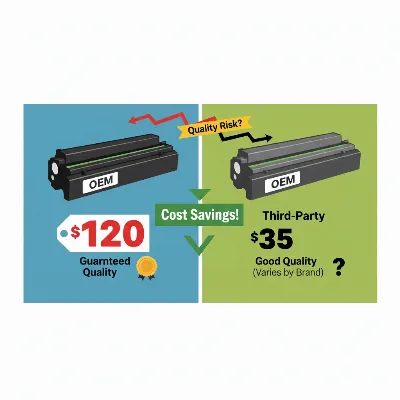 Comparison of OEM and third-party toner cartridges in terms of cost and quality for laser printers
Top Considerations When Choosing Toner in 2026
The choice between OEM and third-party toner cartridges is not one-size-fits-all. Your specific printing habits, priorities, and budget should guide your decision.
Your Printing Needs
- What kind of documents do you primarily print? For high-volume text documents, invoices, or internal reports where razor-sharp text is necessary but color precision is not critical, a high-quality compatible toner is often an excellent choice.
- Do you print photos or color-critical graphics? For professional photography, graphic design, or important client-facing color documents, OEM toner or top-tier compatible options might be preferable to ensure the highest color accuracy and longevity.
- How frequently do you print? For occasional home use, the cost savings of third-party options are compelling. For heavy office use, the consistency and reliability of OEM might offer greater peace of mind, though high-volume businesses also see the greatest savings from compatibles.
Budget Considerations
- What is your upfront budget? Third-party cartridges offer significant initial cost savings.
- Consider the total cost of ownership (TCO). This includes the cartridge price, potential repair costs if a faulty cartridge damages your printer, and the value of your time if you encounter print quality issues or compatibility problems. While OEM cartridges have a higher upfront cost, their consistent performance can sometimes lead to lower TCO over the long run, particularly in professional settings where downtime is costly.
Desired Features
- Connectivity: Modern printers often come with Wi-Fi, Ethernet, and cloud printing capabilities. Ensure any toner, OEM or third-party, doesn’t interfere with these features.
- Duplex Printing: If automatic double-sided printing is essential, ensure the toner’s quality and fit support smooth paper handling.
- Page Yield: Compare the stated page yield (at 5% coverage) of both OEM and third-party options. Reputable compatibles often match OEM yields.
Brand Reputation and Support
- Printer Brand: Some printer brands (e.g., HP, Brother) are known for more aggressively using firmware updates to deter third-party cartridges. While not a reason to avoid compatibles entirely, it’s a factor to be aware of.
- Third-Party Supplier Reputation: As highlighted, buying from a trusted supplier with excellent customer support, clear guarantees, and positive reviews is paramount for mitigating risks.
Conclusion
The landscape of toner cartridges in 2026 offers a clear choice: the proven reliability of OEM or the enticing cost savings of third-party alternatives. While OEM cartridges offer guaranteed performance and seamless integration, the advancements in compatible and remanufactured options mean that significant savings no longer automatically equate to sacrificing quality or safety. The key lies in being an informed consumer. By prioritizing reputable suppliers, verifying compatibility, and understanding the nuances of print quality and warranty implications, you can confidently choose a third-party toner that is safe, effective, and economical for your laser printer. Making an educated decision allows you to optimize your printing costs without compromising your machine’s health or your print output.
What strategies do you employ to balance printing costs with quality and reliability in your home or office?
Frequently Asked Questions
Will using a third-party toner cartridge damage my laser printer?
High-quality third-party toner cartridges from reputable suppliers are generally safe and rigorously tested to prevent damage to your laser printer. However, poorly manufactured or cheap, unverified cartridges can pose risks such as toner leaks, clogging, or component wear, which could potentially cause damage. Always choose trusted brands.
Does a printer’s warranty become void if I use compatible toner?
No, using third-party toner cartridges does not automatically void your printer’s warranty in many countries, thanks to consumer protection laws. However, if a third-party cartridge is directly proven to be the cause of specific printer damage, the manufacturer may not cover the repair for that particular issue.
Is the print quality of third-party toner comparable to OEM?
For everyday text documents and general office printing, many high-quality third-party toner cartridges deliver print quality that is largely comparable to OEM options. For specialized tasks requiring precise color matching or extremely high resolution, such as professional photography, OEM might still offer a slight edge.
Can firmware updates block third-party toner cartridges?
Yes, printer manufacturers occasionally release firmware updates that can detect and potentially block non-OEM cartridges, leading to error messages or printing restrictions. Reputable third-party cartridge manufacturers often work to update their products to maintain compatibility, but this can be an ongoing challenge.
Are third-party toner cartridges environmentally friendly?
Many third-party toner cartridges, particularly remanufactured ones, are considered more environmentally friendly than new OEM cartridges. They promote the reuse of existing materials, reducing waste and the demand for new plastics and raw materials, thereby lowering their overall carbon footprint.
