In the demanding world of legal practice, where volumes of documents, contracts, and court filings are an everyday reality, the right equipment is not just an asset—it’s a necessity. Slow, unreliable, or insecure printers can create critical bottlenecks, compromise client confidentiality, and ultimately impact a firm’s productivity and reputation. For law firms navigating the complexities of 2026, choosing a high-volume laser printer designed for the rigorous demands of legal work is paramount. This comprehensive guide will dissect the essential features, types, and top recommendations to help your firm make an informed decision and invest in printing solutions that streamline workflows, ensure security, and deliver unparalleled efficiency.
What is a Laser Printer? (Definition and Operation Principle)
A laser printer operates on a fundamentally different principle than its inkjet counterpart, utilizing a sophisticated electrostatic digital printing process. At its core, a laser printer employs a laser beam to project an image of the desired text or graphics onto a photosensitive drum. This drum, coated with a photoconductive material, develops an electrostatic charge only in the areas where the laser has struck. Fine, powdered toner, which carries an opposite electrostatic charge, then adheres to these charged areas on the drum. The toner image is subsequently transferred from the drum to the paper, and finally, a fuser unit—a pair of heated rollers—melts and presses the toner onto the paper, creating a permanent, smudge-proof print.
This process differs significantly from inkjet printers, which spray microscopic droplets of liquid ink onto paper. Laser technology is renowned for its speed, particularly when handling large text-based documents, and its ability to produce incredibly crisp, professional-quality text with sharp edges. While inkjet printers often excel in producing vibrant, continuous-tone photographs, laser printers are the undisputed champions for the high-volume, precision text output critical in legal environments.
Advantages and Disadvantages of Laser Printers for Legal Practices
When it comes to equipping a law firm, the choice of printer significantly impacts daily operations. Laser printers, in particular, offer a distinct set of benefits and drawbacks that legal professionals must weigh carefully.
Advantages
|
Our Picks for the Best Laser Printer in 2026
As an Amazon Associate I earn from qualifying purchases.
|
||
| Num | Product | Action |
|---|---|---|
| 1 | Brother HL-L2460DW Wireless Compact Monochrome Laser Printer with Duplex, Mobile Printing, Black & White Output | Includes Refresh Subscription Trial(1), Works with Alexa |

|
| 2 | Brother HLL6210DW Business Monochrome Laser Printer with Large Paper Capacity, Wireless and Gigabit Ethernet Networking, Advanced Security Features and Mobile Printing (Renewed Premium) |
|
| 3 | Brother DCP-L2640DW Wireless Compact Monochrome Multi-Function Laser Printer with Copy and Scan, Duplex, Black & White Output | Includes Refresh Subscription Trial(1), (Renewed Premium) |
|
| 4 | HP LaserJet MFP M235sdw All-in-One Laser Wireless Printer, Scan/Copy, Black & White, Duplex, Best-for-Office |
|
| 5 | Canon imageCLASS MF284dw Wireless Black & White Laser Printer – All-in-One for Home Use, Print/Copy/Scan, 2-Sided Printing, 35 PPM, Auto Doc Feeder, Mobile Device Compatible, Starter Toner Included |
|
| 6 | Brother HL-L2405W Wireless Compact Monochrome Laser Printer with Mobile Printing, Black & White Output | Includes Refresh Subscription Trial(1), Works with Alexa |
|
| 7 | Brother DCP-L2640DW Wireless Compact Monochrome Multi-Function Laser Printer with Copy and Scan, Duplex, Mobile, Black & White | Includes Refresh Subscription Trial(1), Works with Alexa |
|
| 8 | Brother MFC-L2820DW Wireless Compact Monochrome All-in-One Laser Printer with Copy, Scan and Fax, Duplex, Black & White | Includes Refresh Subscription Trial(1), Works with Alexa |
|
| 9 | HP Laserjet MFP M234dw Wireless Printer, Print, scan, Copy, Fast speeds, Easy Setup, Mobile Printing, Best-for-Small Teams, Instant Ink Eligible |
|
| 10 | Brother HLL3280CDW Wireless Compact Color Laser Printer, Duplex, Mobile Printing & Ethernet | Includes 2 Month Refresh Subscription Trial¹, Amazon Dash Replenishment Ready (Renewed Premium) |
|
The benefits of integrating laser printers into a legal practice are substantial, directly addressing many of the industry’s unique demands. Firstly, their high print speed is a game-changer for handling large discovery documents, contracts, and filings, drastically reducing wait times and preventing workflow bottlenecks. Secondly, laser printers deliver superior print quality, producing exceptionally sharp, professional text with high resolution (often 600 DPI or more), which is vital for the legibility of fine print in legal documents. Moreover, the lower cost per page over the long term, especially for monochrome printing, makes them highly economical for firms with significant print volumes, despite a potentially higher initial investment. Laser printers are also built for durability and reliability, designed to withstand heavy workloads month after month without frequent breakdowns. Finally, their prints are instantaneously dry, eliminating the risk of smudging—a critical factor for documents that require immediate handling or signing.
Disadvantages
Despite their many advantages, laser printers do present a few considerations. The most notable is their higher upfront cost compared to many inkjet models, which can be a barrier for smaller firms or those with tighter budgets. Their physical size is also typically larger, often requiring more office space, which might be a constraint for compact offices. While modern laser printers have improved, some models can still emit small amounts of ozone during operation, though this is generally well within safety standards in a well-ventilated office. Lastly, while color laser printers offer good quality for business graphics, they are generally more expensive to run for color output than monochrome models and may not match the photo-realistic quality of specialized inkjet photo printers, making them less ideal for highly detailed photographic evidence where color accuracy is paramount.
Types of Laser Printers Common in Law Firms
Understanding the different categories of laser printers can help law firms pinpoint the exact solution for their diverse printing needs, from basic text documents to comprehensive legal bundles.
Monochrome (Black and White) Laser Printers
These printers are the workhorses of any law firm, specifically designed for efficiency and economy in text-heavy environments. Monochrome laser printers are ideal for producing contracts, pleadings, court filings, and general correspondence where color is unnecessary. Their primary advantages include the lowest cost per page due to more affordable black toner and their exceptionally fast printing speeds. For a firm churning out thousands of pages of documents daily, a dedicated monochrome laser printer can significantly boost productivity and reduce operational expenses.
Color Laser Printers
While monochrome remains the standard for most legal documents, color laser printers serve a crucial role for specific applications. They are essential for creating professional presentations, client-facing marketing materials, and, critically, for printing photographic evidence or exhibits where color accuracy conveys vital details. Although the cost per color page is higher than monochrome, modern color laser printers offer excellent quality for business graphics and documents that require color coding or visual emphasis. Firms can balance cost-efficiency by using monochrome for daily tasks and a color laser for targeted projects.
Multifunction Laser Printers (All-in-One)
Multifunction Printers (MFPs), also known as All-in-One devices, combine printing, scanning, copying, and often faxing capabilities into a single unit. For law firms, especially small to medium-sized ones, MFPs offer unparalleled convenience and space-saving benefits. The key for legal practices is to select MFPs with robust Automatic Document Feeders (ADF) that support single-pass duplex scanning, allowing rapid digitization of multi-page, double-sided documents—a common task for case files and discovery. While some firms might opt for dedicated, ultra-fast scanners for extremely high-volume digitization, a high-quality laser MFP can capably handle most of a firm’s comprehensive document management needs.
Key Factors When Choosing a High-Volume Laser Printer for Your Law Firm
Selecting the ideal high-volume laser printer for a law firm involves more than just looking at the price tag. Several critical factors must align with the unique operational demands and security requirements of a legal environment to ensure optimal performance and long-term value.
Print Speed and Monthly Duty Cycle
For a law firm, print speed (pages per minute, PPM) is a direct measure of productivity. High-volume firms should target printers capable of 50 PPM or more to prevent bottlenecks during large print jobs. Equally important is the monthly duty cycle, which indicates the maximum number of pages a printer can produce in a month without excessive wear. A robust duty cycle (e.g., 100,000 to 275,000 pages) is crucial for sustained reliability under heavy legal workloads, ensuring the machine can consistently meet demands without premature failure.
Print Quality and Resolution
The legibility and professional appearance of legal documents are non-negotiable. Laser printers excel in producing crisp, sharp text, which is essential for contracts and court submissions. Look for models with a print resolution of at least 600×600 dots per inch (DPI); for documents with very fine print or detailed graphics, 1200 DPI or higher can provide an added layer of clarity. Laser prints are also instantly dry, eliminating the risk of smudging, which is critical for documents that undergo frequent handling.
Paper Handling and Capacity
Efficient paper handling is vital to avoid constant refills and interruptions. Firms should prioritize printers with large paper input trays, ideally with a minimum capacity of 500 sheets, and expandable options to further increase capacity. Crucially, the printer must support legal-size paper (8.5″ x 14″), a standard format for many legal documents. Automatic duplex printing (two-sided printing) is also a mandatory feature, saving paper and presenting documents professionally. For multifunction devices, a reliable Automatic Document Feeder (ADF) with duplex scanning capabilities is essential for quickly digitizing multi-page, double-sided originals.
Security Features
Confidentiality is the bedrock of legal practice, making robust security features paramount. Printers in law firms often handle sensitive client information, so look for:
- Secure Print Release: Requires a PIN or card swipe at the device to retrieve print jobs, preventing unauthorized access to sensitive documents left on output trays.
- Encrypted Data Transmission: Ensures data is secure when sent to the printer, scanned to email, or uploaded to cloud storage.
- User Authentication: Controls who can use certain functions or access specific printer features.
- Audit Logs: Provides a record of who printed what and when, useful for compliance and accountability.
- Hard Drive Protection: For MFPs with internal storage, features like secure erase can prevent data recovery after documents are processed.
Cost of Ownership
Beyond the initial purchase price, the long-term cost of ownership significantly impacts a firm’s budget. This includes:
- Toner Cartridge Yield and Cost Per Page: High-yield toner cartridges generally offer a lower cost per page, making them more economical for high-volume use.
- Energy Efficiency: Look for Energy Star certified models to reduce electricity consumption.
- Maintenance Contracts and Support: Reliable service and readily available support can minimize downtime and unexpected repair costs, which is crucial for maintaining workflow.
Connectivity and Integration
Modern law offices require printers that seamlessly integrate with their existing IT infrastructure and digital workflows. Essential connectivity options include wireless (Wi-Fi), Ethernet for network access, and USB. Support for mobile printing technologies like Apple AirPrint or manufacturer-specific apps allows legal professionals to print securely from smartphones and tablets. Furthermore, the ability to integrate with document management systems (DMS) and cloud services can significantly streamline digital archiving and collaboration.
Top High-Volume Laser Printers Recommended for Law Firms in 2026
For law firms aiming for peak efficiency and robust security, several laser printer models stand out as top contenders in 2026, offering a blend of speed, quality, and essential features tailored for legal environments.
- HP LaserJet Enterprise M611dn/M612x Series: These monochrome powerhouses are designed for ultra-high-volume printing, offering speeds up to 65-75 pages per minute and monthly duty cycles reaching 275,000 pages. Their enterprise-level security features, advanced paper handling, and exceptional reliability make them ideal for large firms with intensive black-and-white document production.
- Brother MFC-L8905CDW / MFC-L5915DW: These multifunction laser printers (MFPs) are excellent all-around choices, available in both color (MFC-L8905CDW) and monochrome (MFC-L5915DW) variants. They offer strong print speeds (up to 31 PPM for color/mono), high monthly duty cycles, and robust scanning capabilities with single-pass duplex ADFs. Their user-friendly interfaces, secure function lock, and good cost-per-page with high-yield toner make them suitable for mid-to-large firms needing versatile document handling.
- Canon Color imageCLASS MF665Cdw / MF753Cdw: The Canon imageCLASS series consistently delivers a strong balance of speed, quality, and features for law firms. Models like the MF665Cdw offer print speeds up to 35 PPM (color/mono), high-resolution output, and automatic duplex printing and scanning. They integrate robust security features and offer a competitive cost per page with high-yield toner cartridges, making them excellent for firms requiring reliable color multifunctionality.
- HP Color LaserJet Managed MFP E786dn: Designed specifically for enterprise environments, this multifunction color laser printer offers flexible speeds (from 25 PPM, upgradable to 35 PPM) and robust security tools. It handles legal-size documents with ease and features high-speed duplex scanning, making it a powerful solution for large legal departments or firms managing complex, document-heavy color workflows.
- Konica Minolta bizhub C300i: This enterprise-grade color/monochrome MFP balances performance with advanced security and integration capabilities. With speeds up to 30 PPM, excellent paper handling, and sophisticated scan features, the bizhub C300i is tailored for seamless integration with document management systems, providing a comprehensive solution for modern, tech-forward law firms.
Comparison Table: Leading High-Volume Laser Printers for Law Firms
| Feature | HP M612x Series | Brother MFC-L8905CDW | Canon MF665Cdw | HP E786dn Managed | Konica Minolta C300i |
|---|---|---|---|---|---|
| Type | Monochrome Laser | Color MFP Laser | Color MFP Laser | Color MFP Laser | Color MFP Laser |
| Speed (PPM) | Up to 75 ppm | Up to 31 ppm (color/mono) | Up to 35 ppm (color/mono) | Up to 25-35 ppm | Up to 30 ppm (color/mono) |
| Monthly Duty Cycle | Very High (275k+) | High (60k-80k) | High (75k-80k) | Very High (100k-150k+) | High (80k-100k) |
| Duplex Print/Scan | Yes | Yes | Yes | Yes | Yes |
| Paper Capacity | Expandable (1000+ sheets) | Good (up to 850 sheets) | Good (up to 850 sheets) | Excellent (2000+ sheets) | Excellent (1000+ sheets) |
| Security Features | Advanced (Secure Print, Encryption) | Strong (Secure Function Lock) | Strong (Secure Print) | Enterprise-level | Advanced |
| Cost per Page | Very Low (Monochrome) | Low (with high-yield) | Moderate (with high-yield) | Moderate (with managed plans) | Moderate |
| Best For | Ultra-high volume B&W | All-around color/mono | Mid-to-large firm color | Large enterprise, robust | Integrated office solutions |
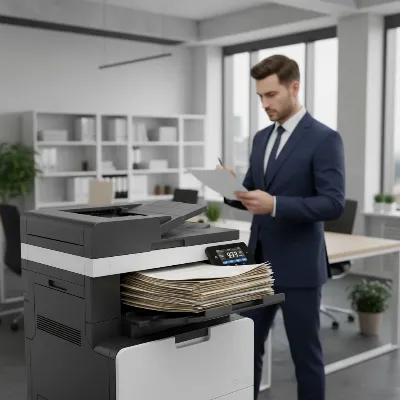 High-volume laser printer in a modern law firm office, printing stacks of documents quickly with a lawyer reviewing them in the foreground.
Conclusion
For law firms in 2026, the printer is far more than a peripheral device; it’s a central component of an efficient, secure, and productive operation. Investing in a high-volume laser printer tailored to the unique demands of legal work is an investment in your firm’s future. By prioritizing factors such as robust print speed and duty cycle, impeccable print quality, advanced security features, versatile paper handling, and a favorable total cost of ownership, firms can select a device that not only keeps pace with their heavy workloads but also safeguards sensitive information and enhances overall professionalism.
Carefully evaluate your specific needs—whether it’s ultra-fast monochrome printing for daily filings, reliable color for evidentiary materials, or an all-in-one solution for comprehensive document management. The right laser printer will serve as a dependable partner, ensuring every document is produced with precision, speed, and uncompromising security.
Which high-volume laser printer will power your firm’s future successes in 2026 and beyond?
Frequently Asked Questions
Why do law firms prefer laser printers over inkjet printers?
Law firms predominantly favor laser printers because they offer significantly faster print speeds for high volumes of text, produce exceptionally crisp and professional-quality text, and have a lower cost per page over time, especially for monochrome documents. Additionally, laser prints are instantly dry, preventing smudging, which is crucial for frequently handled legal paperwork.
What is a good print speed for a law firm printer?
For most law firms handling high volumes of documents, a print speed of at least 25-30 pages per minute (PPM) is considered a minimum. For larger firms or those with extremely heavy workloads, printers offering 50 PPM or more are highly recommended to prevent bottlenecks and maintain efficient workflows.
How important are security features in a legal printer?
Security features are critically important in legal printers due to the highly confidential nature of client information. Features such as secure print release (requiring authentication), encryption for data in transit and at rest, user authentication, and audit logs are essential to protect sensitive documents from unauthorized access and ensure compliance with privacy regulations.
Can a single multifunction printer handle all of a law firm’s needs?
Yes, a well-chosen multifunction printer (MFP) can often handle a law firm’s diverse needs by combining printing, scanning, copying, and faxing functions in one device. This saves space and can be cost-effective. However, firms with exceptionally high-volume scanning requirements might consider supplementing an MFP with a dedicated, ultra-fast document scanner for specialized tasks.
What does “monthly duty cycle” mean and why is it important for law firms?
The monthly duty cycle refers to the maximum number of pages a printer is designed to produce in a month without experiencing undue wear and tear. For law firms, which often have demanding, high-volume printing needs, a robust monthly duty cycle (e.g., 100,000 to 275,000 pages for enterprise models) indicates the printer’s durability and ability to reliably handle consistent heavy use without premature breakdowns, ensuring long-term performance.
How can law firms reduce printing costs?
Law firms can reduce printing costs by investing in laser printers (especially monochrome models) due to their lower cost per page for toner, utilizing automatic duplex (two-sided) printing to save paper, choosing high-yield toner cartridges, and opting for energy-efficient printer models. Additionally, implementing secure print release can prevent unnecessary prints, and regular maintenance can extend a printer’s lifespan.
