In a bustling office environment, productivity hinges on reliable equipment. Among these, the printer stands as a cornerstone, often handling thousands of pages daily. When it comes to managing substantial document loads, an all-in-one laser printer isn’t just a convenience; it’s an absolute necessity. But with countless models on the market, how do you pinpoint the one that can truly withstand the rigors of heavy office use? This comprehensive guide will navigate you through the world of laser printer technology, highlight their distinct advantages, and ultimately help you select the ideal all-in-one workhorse to keep your operations running smoothly and efficiently.
What is a Laser Printer? (Definition and Working Principle)
At its core, a laser printer is a sophisticated device that leverages electrostatic digital printing to produce sharp, high-quality text and graphics. Unlike inkjet printers that spray liquid ink, laser printers employ a dry, powdered substance called toner. The magic begins when a precisely controlled laser beam etches an invisible electrostatic image onto a photosensitive drum. This drum then selectively attracts toner particles to these charged areas, effectively forming the print image. The toner is subsequently transferred from the drum onto a sheet of paper, which then passes through a fuser unit. Here, intense heat and pressure permanently bond the toner to the paper fibers, resulting in a durable, smudge-resistant printout. This ingenious process allows laser printers to deliver documents with exceptional clarity and speed.
This foundational technology, pioneered by Gary Starkweather at Xerox in 1969, quickly revolutionized office printing, moving from initial commercial availability in 1976 to widespread adoption by the mid-1980s. Its inherent speed and efficiency quickly made it the preferred choice for businesses over earlier impact dot matrix printers and even early inkjet models.
Advantages and Disadvantages of All-in-One Laser Printers for Office Use
Choosing the right printer for a demanding office environment involves weighing several critical factors. All-in-one laser printers offer a distinct set of advantages that make them particularly well-suited for heavy use, though they also come with certain limitations.
Advantages
|
Our Picks for the Best Laser Printer in 2026
As an Amazon Associate I earn from qualifying purchases.
|
||
| Num | Product | Action |
|---|---|---|
| 1 | Brother DCP-L2640DW Wireless Compact Monochrome Multi-Function Laser Printer with Copy and Scan, Duplex, Mobile, Black & White | Includes Refresh Subscription Trial(1), Works with Alexa |

|
| 2 | HP LaserJet MFP M235sdw All-in-One Laser Wireless Printer, Scan/Copy, Black & White, Duplex, Best-for-Office |
|
| 3 | Brother HLL6210DW Business Monochrome Laser Printer with Large Paper Capacity, Wireless and Gigabit Ethernet Networking, Advanced Security Features and Mobile Printing (Renewed Premium) |
|
| 4 | Brother HL-L2460DW Wireless Compact Monochrome Laser Printer with Duplex, Mobile Printing, Black & White Output | Includes Refresh Subscription Trial(1), Works with Alexa |
|
| 5 | Brother MFC-L2820DW Wireless Compact Monochrome All-in-One Laser Printer with Copy, Scan and Fax, Duplex, Black & White | Includes Refresh Subscription Trial(1), Works with Alexa |
|
| 6 | HP Laserjet MFP M234dw Wireless Printer, Print, scan, Copy, Fast speeds, Easy Setup, Mobile Printing, Best-for-Small Teams, Instant Ink Eligible |
|
| 7 | Brother HLL3280CDW Wireless Compact Color Laser Printer, Duplex, Mobile Printing & Ethernet | Includes 2 Month Refresh Subscription Trial¹, Amazon Dash Replenishment Ready (Renewed Premium) |
|
| 8 | Brother HL-L2405W Wireless Compact Monochrome Laser Printer with Mobile Printing, Black & White Output | Includes Refresh Subscription Trial(1), Works with Alexa |
|
| 9 | Brother DCP-L2640DW Wireless Compact Monochrome Multi-Function Laser Printer with Copy and Scan, Duplex, Black & White Output | Includes Refresh Subscription Trial(1), (Renewed Premium) |
|
| 10 | Canon imageCLASS MF284dw Wireless Black & White Laser Printer – All-in-One for Home Use, Print/Copy/Scan, 2-Sided Printing, 35 PPM, Auto Doc Feeder, Mobile Device Compatible, Starter Toner Included |
|
Laser printers are engineered for performance and endurance, which is precisely what a busy office requires. Their superior speed is a primary benefit, often producing dozens of pages per minute, making them ideal for large print jobs where efficiency is paramount. For text-heavy documents, the print quality of a laser printer is unparalleled, delivering crisp, professional-grade text with sharp lines and clear fonts that resist fading and smudging.
Furthermore, the cost per page (CPP) is generally lower over the long term, especially when dealing with high print volumes. This is because toner cartridges, which contain powdered ink, typically have a much higher page yield than liquid ink cartridges, reducing the frequency and overall expense of replacements. Laser printers are also renowned for their durability and robust construction, built to handle the continuous demands of an office with minimal breakdowns. They require less maintenance, as toner doesn’t dry out or clog printheads, ensuring consistent readiness. Their substantial paper handling capacities, often expandable with additional trays, and the ability to print on various media types, including heavy card stock and labels, add to their versatility.
Disadvantages
Despite their many benefits, all-in-one laser printers do have some drawbacks. The initial purchase price is typically higher than that of comparable inkjet printers, which can be a significant upfront investment for some businesses. Their robust build and internal mechanisms also mean they tend to be larger and heavier, requiring more physical space in an office layout.
While excellent for text and graphics, laser printers are generally not the best choice for printing high-resolution, gallery-quality photographs due to their reliance on toner particles and a more limited color gamut compared to specialized photo inkjet printers. For offices where pristine photo reproduction is a frequent requirement, a separate dedicated photo printer might be necessary. Additionally, some older or less efficient models may emit small amounts of ozone during operation, though modern designs often mitigate this concern.
Common Types of Laser Printers
Understanding the different categories of laser printers can help narrow down your choices based on specific office needs. While this article focuses on all-in-one models, it’s useful to know the distinctions.
Monochrome Laser Printers
Monochrome laser printers, often referred to as black and white laser printers, specialize in printing text documents and simple graphics in a single color: black. They are the fastest and most cost-effective option for offices that primarily deal with high volumes of internal reports, invoices, and other text-based materials. Their toner cartridges are typically very affordable and offer an extremely low cost per page, making them champions of efficiency for black-and-white output.
Color Laser Printers
When presentations, marketing materials, or documents requiring visual emphasis are part of your routine, color laser printers become indispensable. These machines utilize four distinct toner cartridges (Cyan, Magenta, Yellow, and Black) to reproduce a full spectrum of colors. While their operational cost per page is higher than monochrome printers, they deliver vibrant graphics and professional-looking color documents with impressive speed and accuracy, far outperforming inkjet printers for business-grade color text and chart printing.
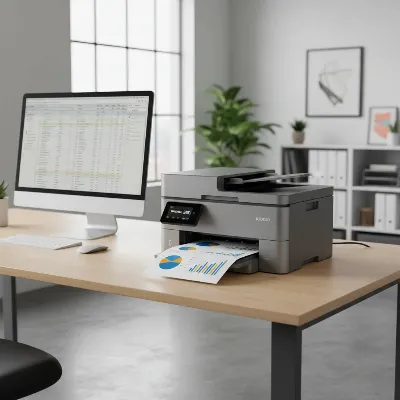 A modern color laser multifunction printer in a bright, organized office environment, printing vibrant charts.
All-in-One Laser Printers (Multifunction Printers – MFPs)
For most contemporary offices, an all-in-one laser printer (also known as a multifunction printer or MFP) is the go-to solution. These versatile devices combine the core functionality of printing with scanning, copying, and often faxing, all within a single footprint. This integration saves valuable office space and streamlines workflows, allowing users to perform multiple tasks from one centralized machine. Many modern AIO laser printers also feature advanced capabilities like automatic duplexing (two-sided printing, scanning, and copying) and robust automatic document feeders (ADFs), making them incredibly efficient for digitizing and managing paper documents in a busy work environment.
Key Factors to Consider When Choosing an All-in-One Laser Printer (Buying Guide)
Selecting the best all-in-one laser printer for heavy office use requires a strategic approach. Consider these critical factors to ensure your investment perfectly aligns with your operational demands.
Usage Needs & Print Volume
Before anything else, accurately assess your office’s printing habits. What type of documents do you print most frequently—text, color reports, or a mix? More importantly, what is your monthly print volume? For “heavy office use,” you should be looking at printers with a recommended monthly duty cycle of over 5,000 pages per month, and ideally, closer to 10,000 pages or more. This ensures the printer is designed for sustained, high-volume output without premature wear. If you frequently scan multi-page documents, an automatic document feeder (ADF) with single-pass duplex scanning is a must-have feature for efficiency.
Budget & Running Costs
While the initial purchase price is important, the total cost of ownership (TCO) over the printer’s lifespan is far more critical for heavy office use. This includes the cost of replacement toner cartridges and potential maintenance. Laser printers generally offer a lower cost per page (CPP) compared to inkjets, but there can be significant variations between models and brands. Always research the price and page yield of standard and high-yield toner cartridges for any printer you consider. A slightly more expensive printer upfront with substantially lower ongoing toner costs can save your business thousands in the long run.
Essential Features
- Print Speed (PPM): For heavy office use, aim for a print speed of at least 35-40 pages per minute (PPM), with some top models exceeding 40 PPM.
- Print Resolution (DPI): A resolution of 600 DPI is typically sufficient for crisp text, but if your office prints detailed graphics or high-quality presentations, look for 1200 DPI or higher for superior clarity.
- Connectivity: Modern offices demand versatile connectivity. Ensure the printer supports Wi-Fi, Ethernet (for reliable network connection), and ideally NFC (Near Field Communication) or Wi-Fi Direct for easy mobile printing. Compatibility with cloud services (e.g., Google Drive, Dropbox) is also a plus for scanning directly to cloud storage.
- Automatic Duplexing: This feature allows for automatic two-sided printing, scanning, and copying, significantly saving paper and time. For an ADF, look for “single-pass duplexing” which scans both sides of a document in one pass.
- Paper Capacity: High-volume printing requires substantial paper handling. Look for models with large standard paper trays (250-550 sheets) and the option to add extra paper trays to expand capacity to 1,000+ sheets, minimizing interruptions for refilling.
- User Interface: An intuitive, responsive color touchscreen can greatly enhance usability, making it easier for multiple users to navigate functions.
- Security Features: In an office environment, document security is paramount. Look for features like secure print (PIN release), user authentication, and network security protocols to protect sensitive information.
Brand Reputation & Support
Stick with reputable brands known for their reliability and customer support in the business printer segment. Brother, Canon, and HP are consistently rated highly for their robust laser printers designed for office environments. Investigate warranty options and the availability of local service and technical support, which can be invaluable when unexpected issues arise.
Top All-in-One Laser Printers for Heavy Office Use
For offices that demand unwavering performance and efficiency, certain all-in-one laser printers stand out. Here are some of the best models frequently recommended for heavy-duty use:
1. Brother MFC-L8905CDW (Color All-in-One)
This model is consistently praised as a top-tier workhorse for busy offices. It boasts impressive print speeds of up to 33 pages per minute (PPM) in both color and monochrome, along with a robust monthly duty cycle designed for high-volume environments. Its single-pass duplexing ADF and high-yield toner cartridges contribute to excellent efficiency and a low cost per page. Connectivity options are extensive, including Wi-Fi, Ethernet, and NFC. While it has a larger footprint and a higher upfront cost, its reliability and low running costs make it a sound long-term investment.
2. Canon Color imageCLASS MF753Cdw (Color All-in-One)
The Canon MF753Cdw is a strong contender for offices needing fast color printing and scanning. It offers speeds of up to 35 PPM and features a large 5-inch intuitive color touchscreen, making operation straightforward. This model supports fast scanning and copying, including multi-page duplex copying, and uses high-capacity toner cartridges to keep costs manageable. It’s a reliable choice for mid-sized to large offices that require a balance of speed, color quality, and robust all-in-one functionality.
3. HP Color LaserJet Pro M479fdw (Color All-in-One)
HP’s Color LaserJet Pro M479fdw is renowned for its blend of speed, security, and high-quality output. It delivers fast print speeds for both black and color documents and supports high-yield toner cartridges, reducing the frequency of replacements. Its advanced security features are a significant plus for protecting sensitive office data, and it includes an automatic document feeder with duplex scanning. This printer is an excellent option for offices that prioritize data protection alongside high-volume color and monochrome printing.
4. Brother MFC-L2750DW XL (Monochrome All-in-One)
For offices where color printing is not a primary requirement, the Brother MFC-L2750DW XL offers exceptional value and performance. This monochrome all-in-one printer is a speed demon, reaching over 35 PPM, and boasts one of the lowest costs per page in its class, especially with the extra-large toner cartridge. It features single-pass duplex scanning, wireless connectivity, and the ability to scan directly to cloud services, making it incredibly efficient for text-heavy offices focused on productivity and cost savings.
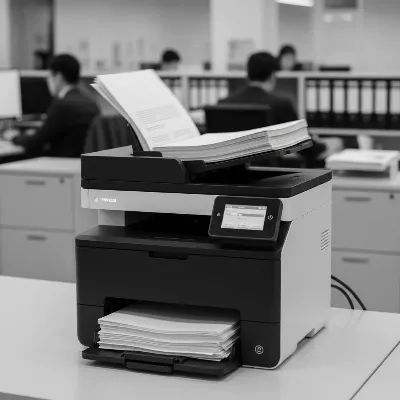 A fast monochrome laser multifunction printer in an office, processing a large stack of papers quickly.
Conclusion
Choosing the right all-in-one laser printer for heavy office use is a decision that profoundly impacts productivity and operational costs. By prioritizing factors such as print speed, monthly duty cycle, cost per page, and essential features like automatic duplexing and robust connectivity, you can ensure your office is equipped with a machine that not only meets but exceeds its demands. The best models from brands like Brother, Canon, and HP are designed to be workhorses, offering the reliability and efficiency necessary to handle thousands of pages with crisp quality and minimal fuss. Investing in a high-performance all-in-one laser printer means streamlining your workflow, reducing downtime, and ultimately contributing to a more efficient and productive workplace. What specific feature is most crucial for your office’s printing needs?
Frequently Asked Questions
What does “heavy office use” mean for a printer?
“Heavy office use” typically refers to printing volumes exceeding 5,000 pages per month, often reaching 10,000 pages or more. It also implies a need for high print speeds (35+ PPM), robust paper handling, consistent performance, and features like automatic duplexing and high-capacity automatic document feeders (ADF) to efficiently manage large workloads.
Are color laser printers suitable for heavy office use?
Yes, many color laser printers are perfectly suitable for heavy office use, especially models designed for business environments. They offer fast speeds, excellent text and graphics quality, and robust construction. However, their cost per page for color prints will be higher than for monochrome prints, so consider your ratio of color to black-and-white printing.
How important is duplex scanning for an office AIO?
Duplex scanning is highly important for an office all-in-one printer, particularly for heavy use. It allows the printer’s automatic document feeder (ADF) to scan both sides of a document automatically. Single-pass duplex scanning is even better, as it scans both sides in one pass, significantly speeding up the digitization of multi-page, two-sided documents and enhancing office efficiency.
What is the average lifespan of a laser printer for heavy use?
The average lifespan of a laser printer designed for heavy office use can range from 5 to 7 years or even longer, depending on the model, brand, maintenance, and how closely its actual usage aligns with its recommended monthly duty cycle. High-quality business-grade models are built with more durable components to withstand continuous operation.
How can I minimize the running costs of an AIO laser printer?
To minimize running costs, opt for printers with a low cost per page (CPP) for both black and color toner. Utilize high-yield or XL toner cartridges, which offer more pages per cartridge at a lower cost per page. Also, take advantage of automatic duplex printing to save on paper, and print in draft mode when document quality is not critical.
